There are two kinds of ancient forest. The kind that knows you are there, and the kind that does not. The mossy woodland of the Isle of Man knows you are there. It watches. The laurissilva forest of Madeira predates you by twenty million years and will not notice when you leave. Both are worth entering. Neither is safe to dismiss.
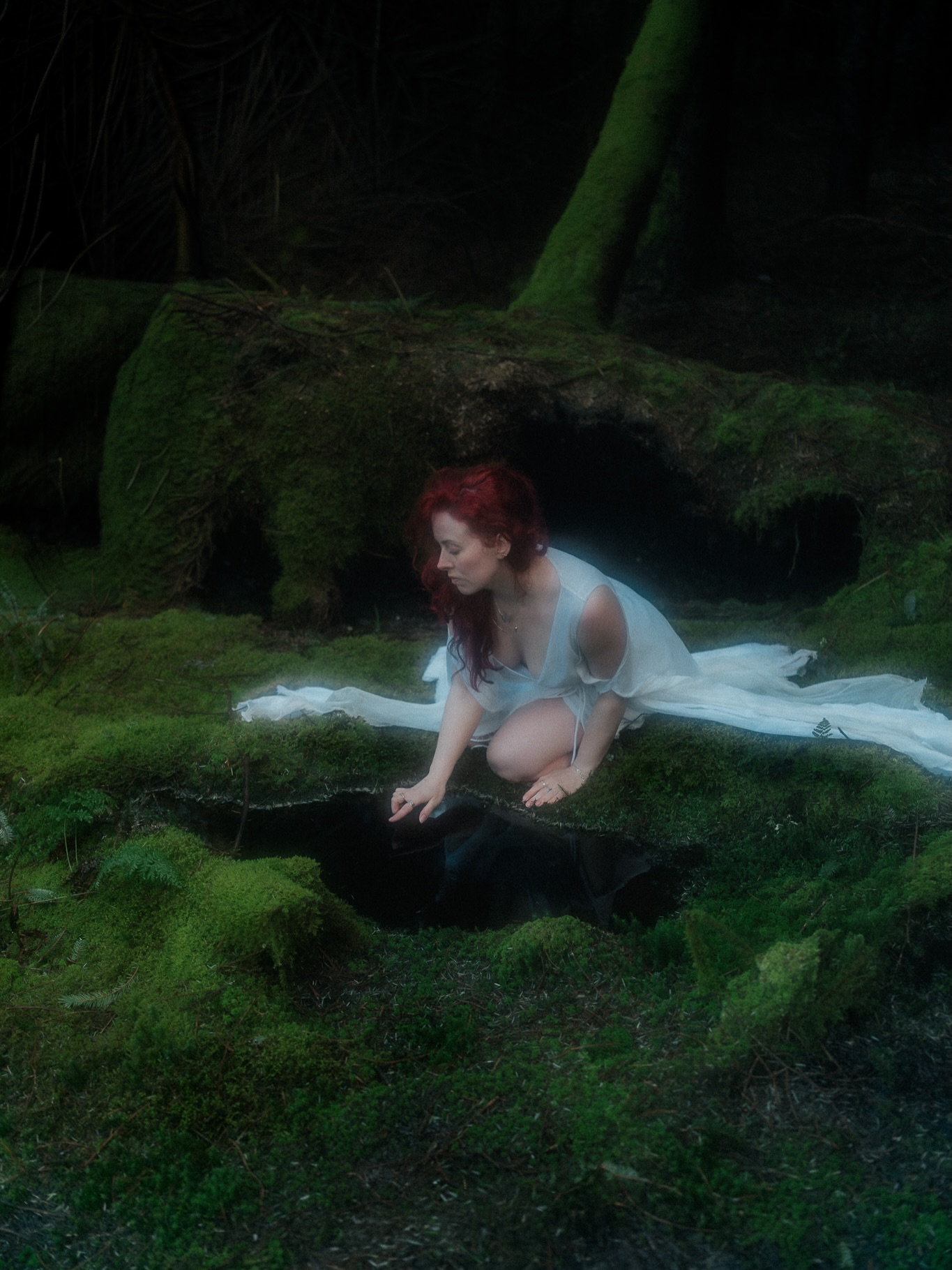
Dark pool in an ancient woodland, Isle of Man — the Glashtyn are said to inhabit places exactly like this.
The Water Spirits of the Manx Glen
The Isle of Man's glens are the most mythologically dense landscape on the island. More than anywhere else — more than the hillforts, more than the stone circles — the glens carry the sense of something listening. Celtic mythology names the creatures of the water and the wood with the specificity of people who spent a great deal of time among them. The Glashtyn was a shape-shifting water spirit associated with dark pools and isolated streams. The Fenodyree was a large and wild spirit of the land. The Lhiannan Shee was a fairy lover who appeared to those who wandered alone in wild places and inspired them toward obsession.
The dark pools of the Manx glens — perfectly still, perfectly black, reflecting nothing but sky and branch — are exactly the kind of place these figures are said to inhabit. Photographing beside them feels like a negotiation. You are in their space. The camera is your excuse to be there.
"The dark pool doesn't reflect. It absorbs. You put your hand in and the water swallows the light around your fingers. I understand why the old stories put spirits here."
— Ciara, wildislandmedia.com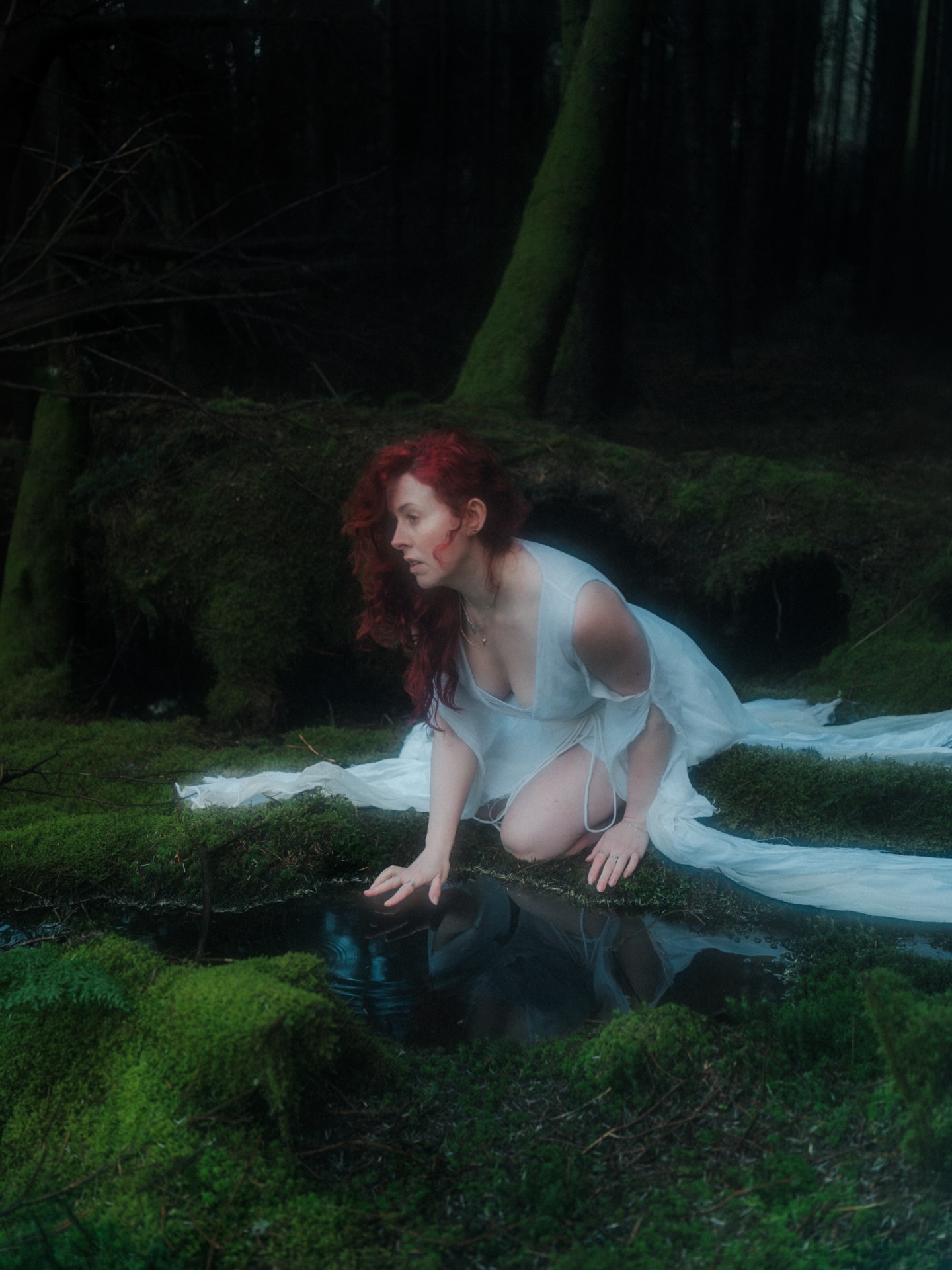
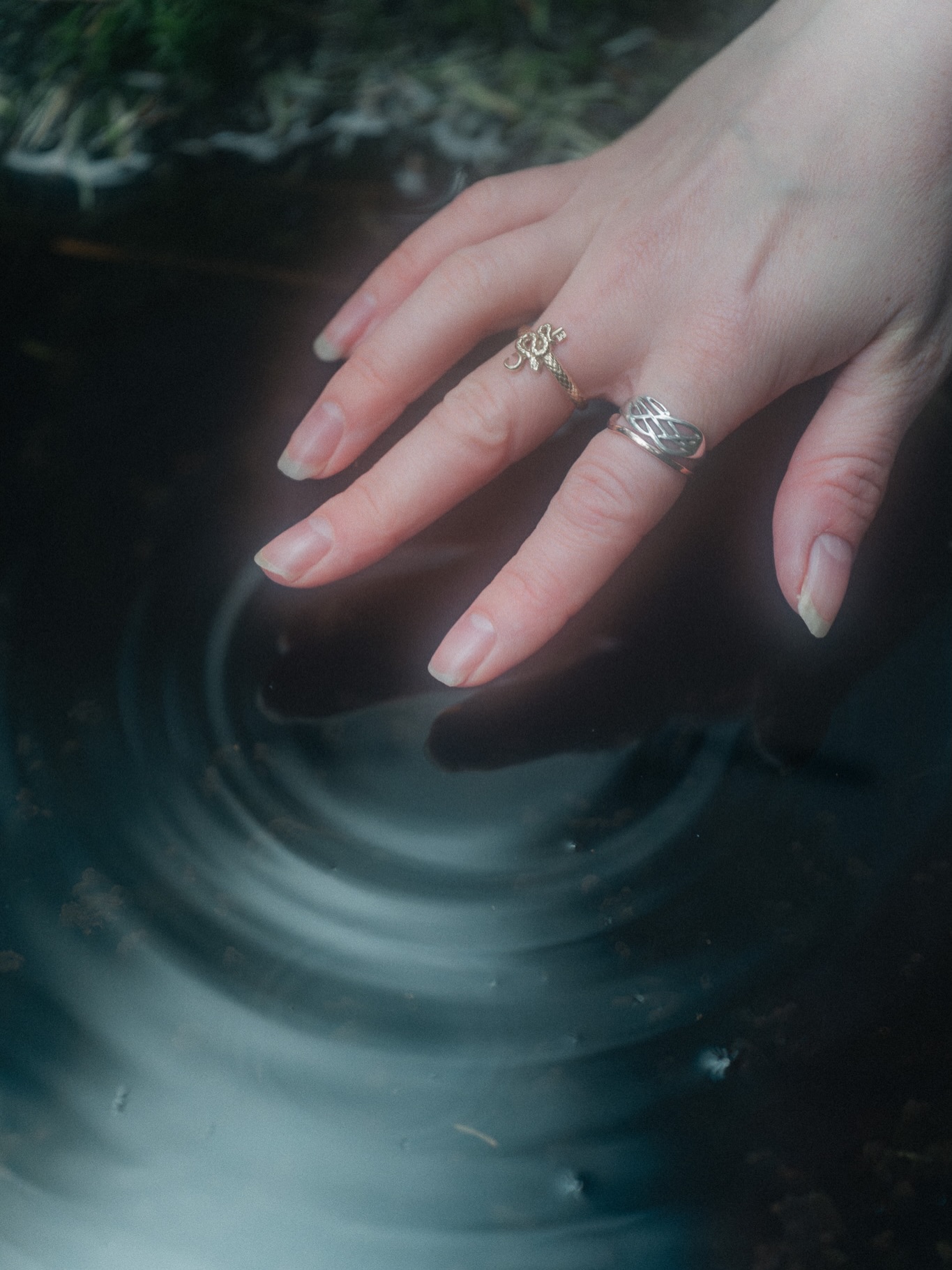
Celtic knotwork rings touching the surface of a dark pool — the moment of contact between the made world and the wild one.
Inside the Tangled Canopy
The ancient hawthorn trees of the Isle of Man are among the most visually arresting things on the island. Twisted into complex formations by decades of coastal wind, bleached white in places, their branches interlocking overhead like the vaulting of a ruined cathedral. They are the kind of trees that appear in every Celtic mythology because they are genuinely uncanny. The Manx tradition holds that hawthorn trees are fairy trees, that cutting one brings misfortune, that they are inhabited and not to be interfered with.
Sitting inside one — balanced in its branches, white dress against dark wood, the mist coming in from the sea. It is not a comfortable thing to do. The branches are not accommodating. But there is something right about the image it makes: the human body placed within a structure that is older and stranger than any building, making itself small inside it rather than imposing upon it.
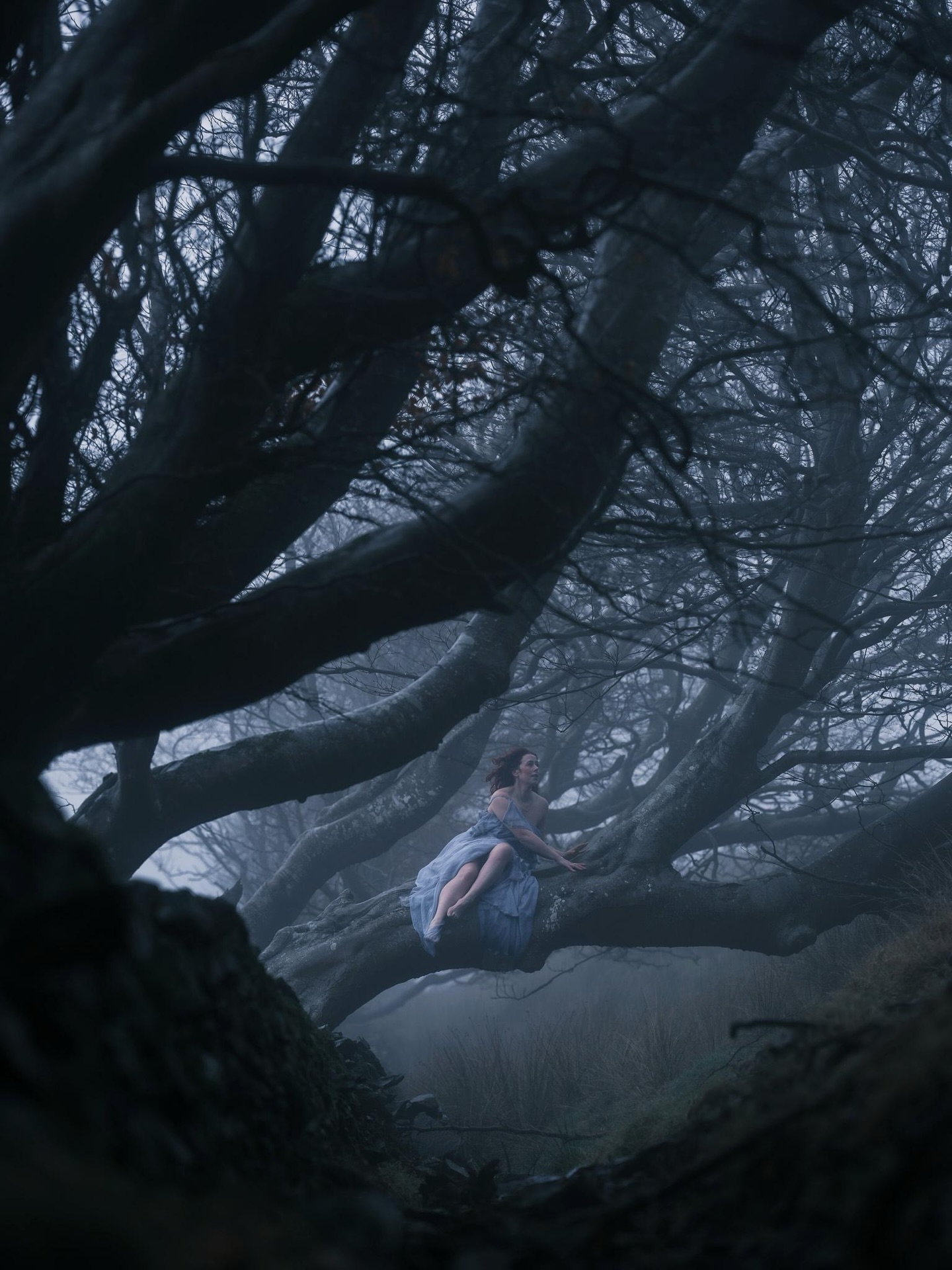
Ancient hawthorn trees, Isle of Man — fairy trees in Manx tradition, not to be cut or interfered with.
The Forest That Survived Everything
The laurissilva forest of Madeira is approximately twenty million years old. During the Miocene and Pliocene periods, this type of subtropical laurel forest covered much of southern Europe and North Africa. Then the ice ages came, the climate shifted, and the great laurel forests retreated to the Atlantic islands: the Azores, the Canaries, and Madeira, where the ocean's warmth kept the air humid enough to sustain them. What remains on Madeira is ninety percent primary forest: Trees over eight hundred years old, in valleys that have never been felled, in an ecosystem that predates the human habitation of the island by millions of years.
The Fanal forest — the most ancient and fog-haunted section of the laurissilva — is the specific place that produces photographs like this. The mist comes in from the Atlantic and settles among the trees without lifting. The trees themselves are gnarled and enormous, their roots visible above the soil, their branches extending horizontally in every direction. Walking into the Fanal on a misty morning is the closest I have come to understanding what forests meant to people before agriculture — not as resource, not as obstacle, but as a world with its own rules that you were temporarily permitted to enter.
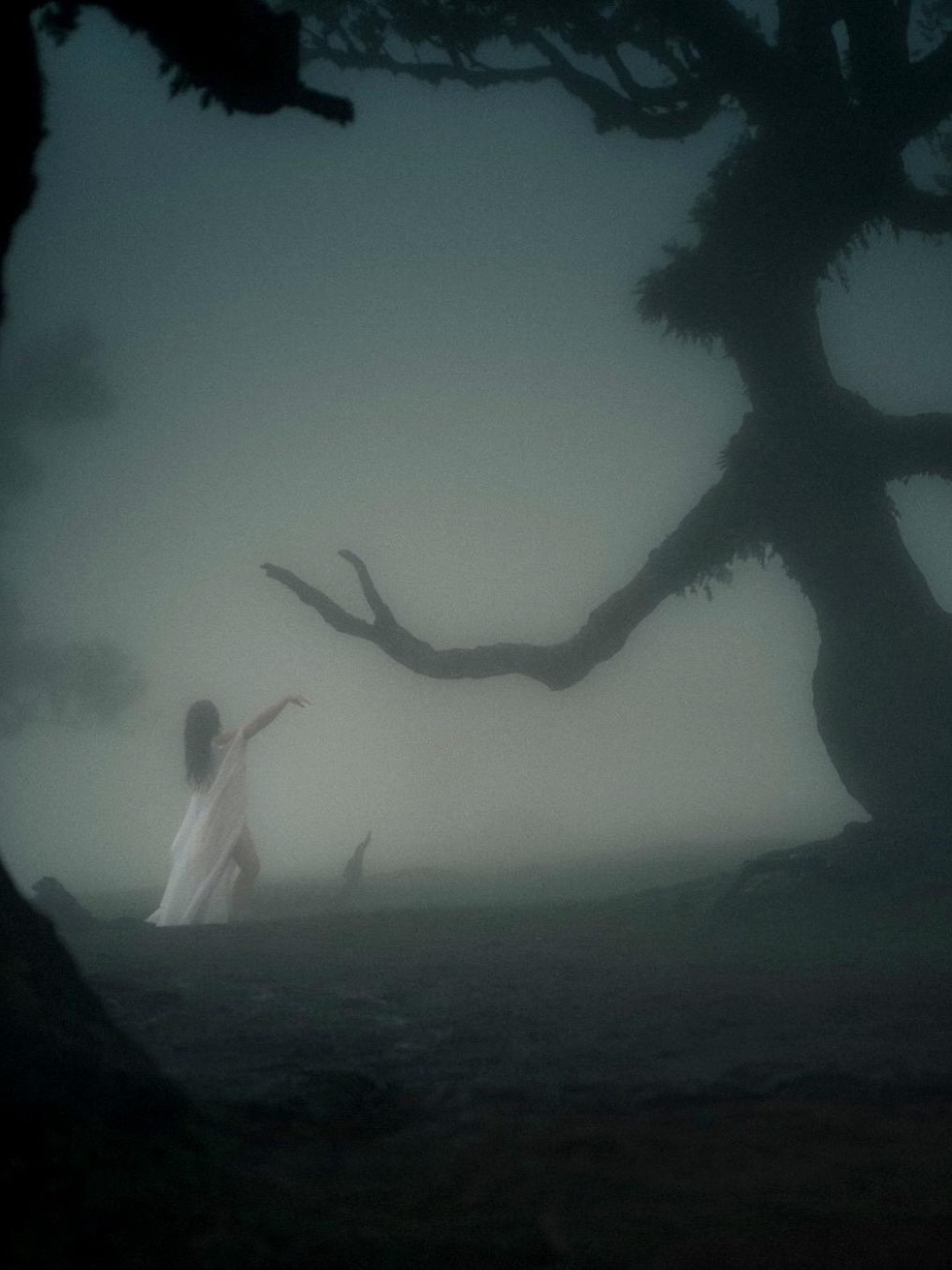
Fanal forest, laurissilva of Madeira — a UNESCO World Heritage site. The laurel forest that once covered southern Europe, now surviving only on the Atlantic islands. Twenty million years old.
"The laurissilva has existed for twenty million years. It was here before the island had a name. Standing inside it, the category of 'ancient' stops meaning anything — you are simply inside something that has always been."
— Ciara, wildislandmedia.comThe connection between the laurissilva and Celtic mythology is not direct — Madeira was uninhabited when the Portuguese arrived in 1419, and has no indigenous mythological tradition in the same way the Isle of Man does. But the experience of the forest produces the same response as the Manx glens: the feeling that you have entered something that has its own logic, that the normal rules of cause and effect have been suspended, that the light and the mist and the root systems underfoot are communicating something you don't have the language for.
What I am interested in, across all of these images, is that threshold. The moment at which the human body — dressed, jewelled, deliberate — encounters a landscape that is indifferent to all of that. The white dress against the dark pool. The rings touching the water. The figure inside the ancient tree. The woman in the mist. These are not images of nature overpowering the human. They are images of the human being genuinely present within nature, which is rarer and harder to photograph than it sounds.
She has Celtic roots. Obviously.
More from the Journal
Field notes from the ancient North — mythology, landscape, and the seasonal pulse of the Celtic world.
Back to Journal →