Every April the blackthorn explodes into white blossom before its leaves have even arrived. The branches are bare and dark and savage, and from them come these dense, improbable clouds of white flowers. It looks like the tree is performing a kind of magic trick. According to Celtic folklore, it is.
The blackthorn grows throughout the Isle of Man's hedgerows and coastal edges. Manx Wildlife Trust records it in bloom from March through April, a froth of white against bare branches, one of the earliest signs that the year is turning. It is one of the triad of faerie trees in Celtic tradition: blackthorn, hawthorn, and rowan. And it is the only one with its own dedicated guardian spirits.
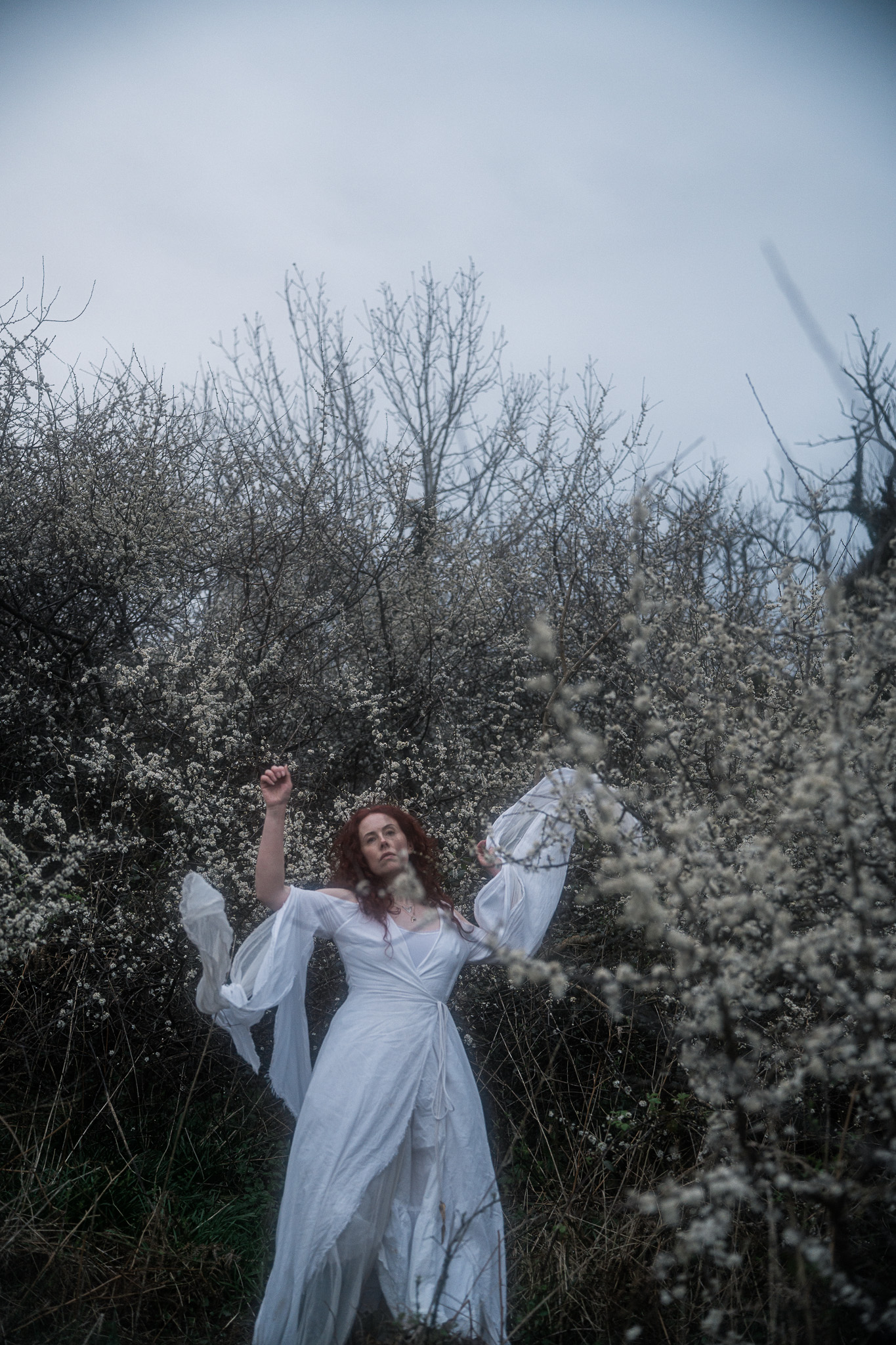
Blackthorn blossom, Isle of Man, April 2026. The tree blooms on bare branches, before a single leaf has appeared.
Luna and the Shee: Moon Fairies of the Thorn
The Lunantishee take their name from two words: Luna, for the moon, and Shee, the Irish Gaelic term for the fairy folk of the Otherworld. They are moon fairies, bound specifically to the blackthorn. Not to all trees, not to the hedgerow in general, but to this one dark, thorned, contrary shrub in particular.
They are not decorative. They do not flutter. They are territorial guardians who have been stationed at the blackthorn since before anyone alive can remember, and they take their role seriously. The clearest account of them comes from an Irish farmer named Patrick, whose testimony was recorded by the folklorist W.Y. Evans-Wentz in his 1911 collection, Fairy Faith in Celtic Countries.
"The Lunantishee are the tribes that guard the blackthorn trees or sloes. They let you cut no stick on the 11th of November, old Samhain, or on the 11th of May, old Beltane. If at such a time you cut a blackthorn, some misfortune will come to you."
Patrick, Co. Galway — recorded in Fairy Faith in Celtic Countries, W.Y. Evans-Wentz, 1911The dates are precise and important. The 11th of November and the 11th of May are the old Julian calendar dates of Samhain and Beltane: the two great hinges of the Celtic year, the festivals at which the veil between worlds is at its thinnest. On those two days, the Lunantishee are at their most vigilant. The blackthorn is not to be touched.
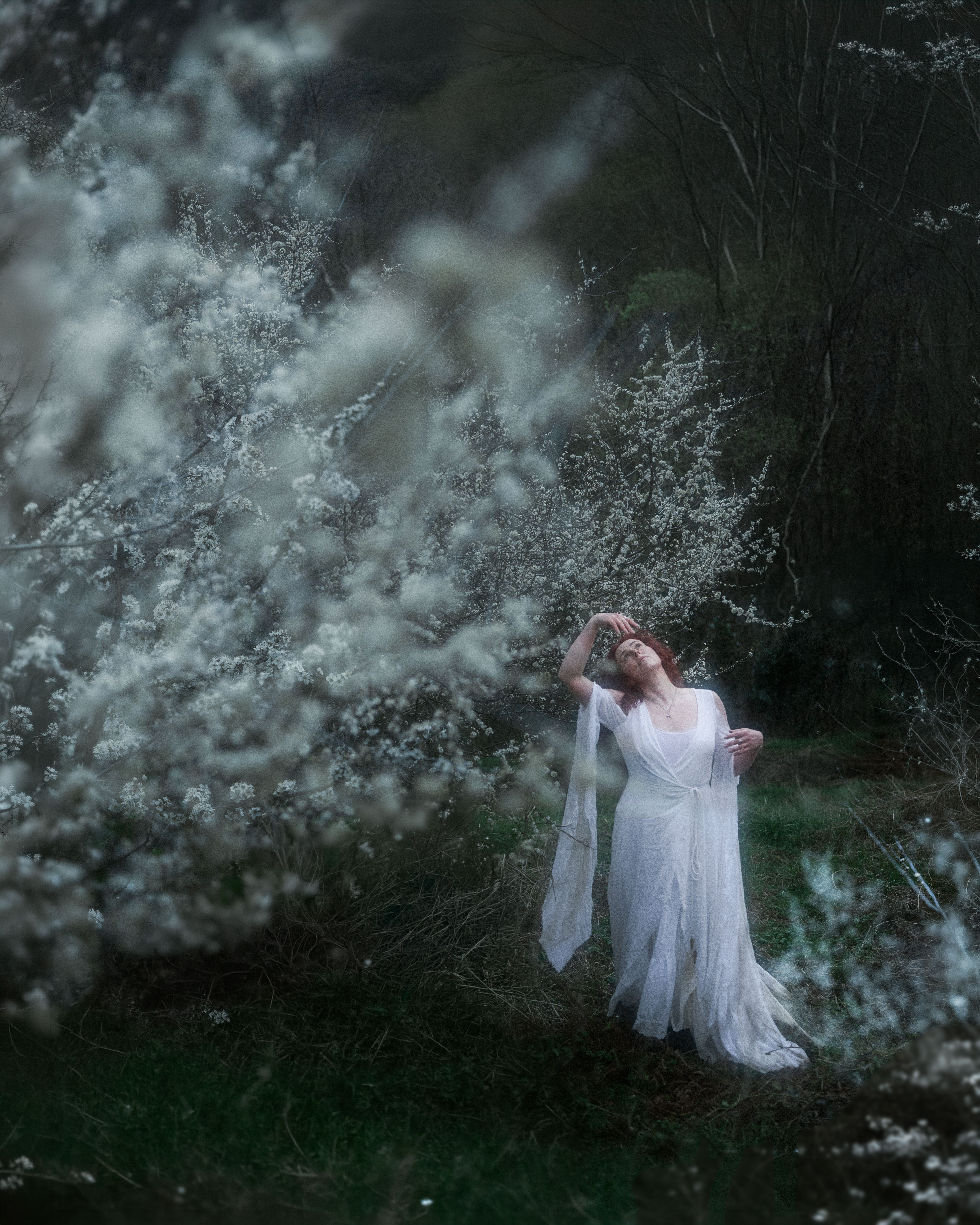
Among the blossoming blackthorn. The Lunantishee only leave the tree at the full moon, to pay homage to the moon goddess. This is said to be the one safe time to approach the tree.
Blossom Before Leaves: The Cold Trick of Spring
The blackthorn has a peculiarity that has been noticed and named across Britain and Ireland for centuries. It blooms before its leaves arrive, which means the white blossom appears on bare dark branches, often during a cold snap in early spring. This phenomenon is called a blackthorn winter: the cold blow that comes when the tree comes into flower. The naturalist William Cobbett wrote in 1825 that every single year, without exception, a spell of cold and angry weather arrived precisely when the blackthorn bloomed, and that country people had been calling it the blackthorn winter for as long as anyone could trace.
On the Isle of Man, the blackthorn typically blooms through March and April. The cold that accompanies it here comes off the Irish Sea: a particular quality of wind that the island knows well, horizontal and persistent, arriving from the west with no warning. Photographing in it is its own instruction in endurance.
The blossom appears on bare, dark, thorned branches. It looks like something impossible. The Cailleach carries a blackthorn staff. The dark crone of winter and the white flowers of spring occupy the same tree at the same moment. That tension is the whole story.
Ciara — Wild Island Media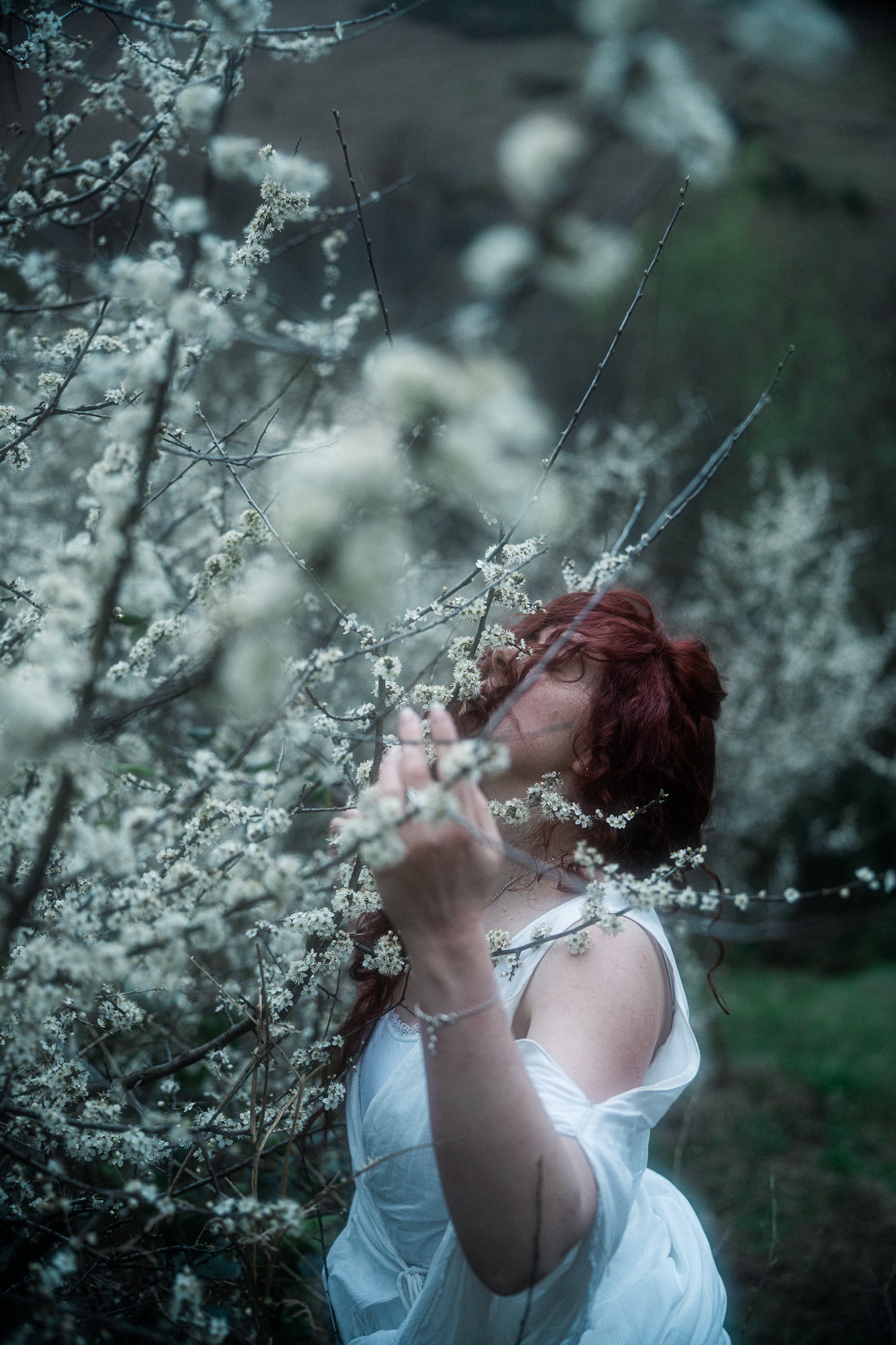
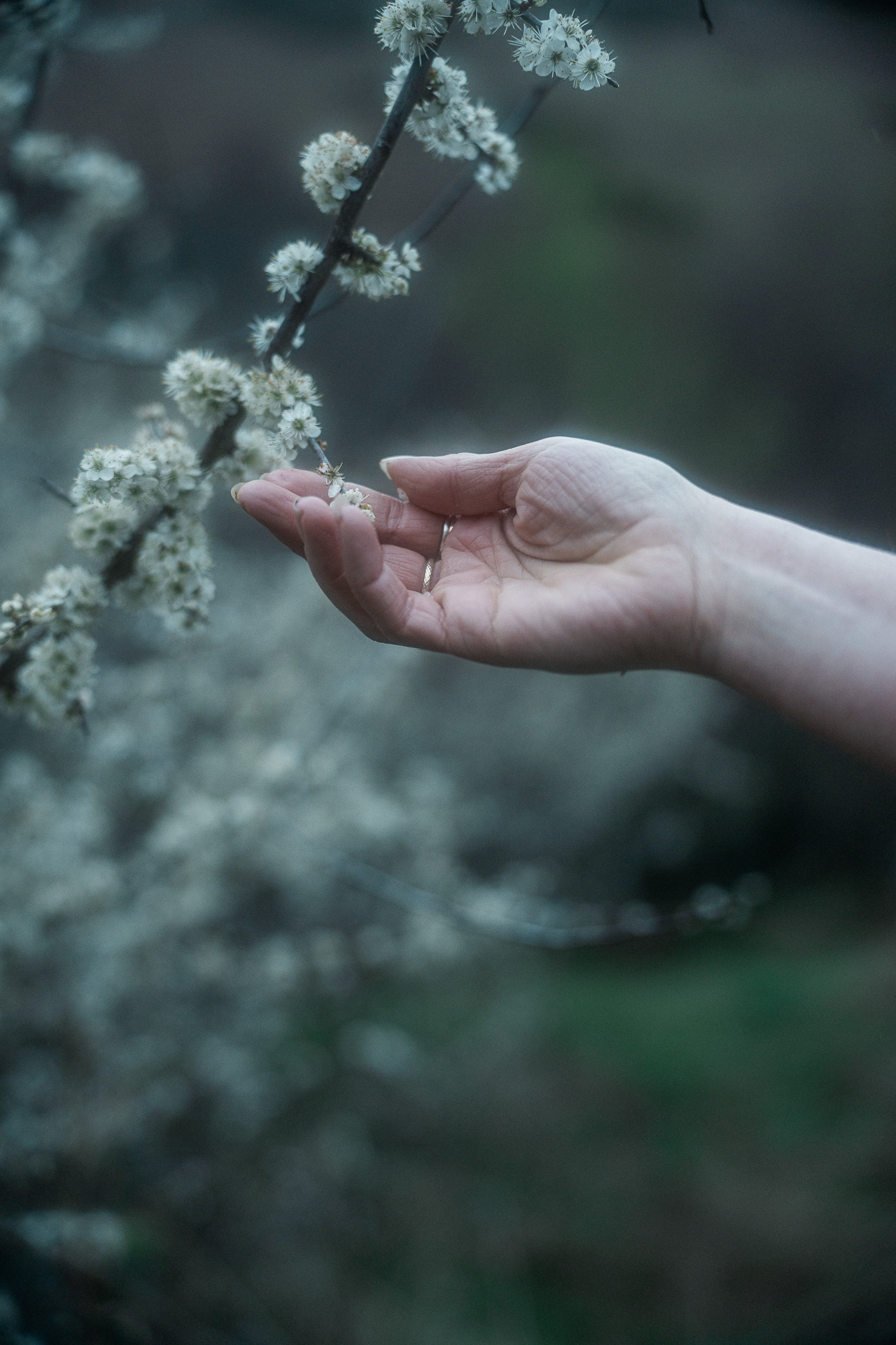
Left: face obscured by the blackthorn. The tree does not part for you. Right: a hand offered to the blossom — the correct posture when approaching a faerie tree is always one of asking, not taking.
The Darkest Letter: Straif and the Meaning of Strife
In the Ogham alphabet, the ancient script of the Celtic world in which each letter corresponds to a tree, the blackthorn is Straif: the fourteenth few. It is widely considered the most sinister letter in the alphabet. Scholars and practitioners translate it variously as strife, trouble, negativity, difficult change, magical power, and transformation. The English word strife is thought by some to derive directly from Straif, carrying the blackthorn's energy into our everyday language without most people knowing it.
What is interesting about these translations is that they do not contradict each other. Strife, difficult change, and magical power belong together. The blackthorn is the tree of thresholds that cost something to cross. It does not promise comfort. It promises transformation, which is a different and more demanding thing.
The Cailleach, the great Crone of winter in both Scottish and Irish mythology, carries a staff of blackthorn. She strikes the ground with it to bring snow and freeze the earth. The same tree that guards with the Lunantishee, that blooms with this extraordinary cold-weather blossom, is the instrument of winter's power. It belongs to the dark and fertile side of the year, the side that does the difficult work.
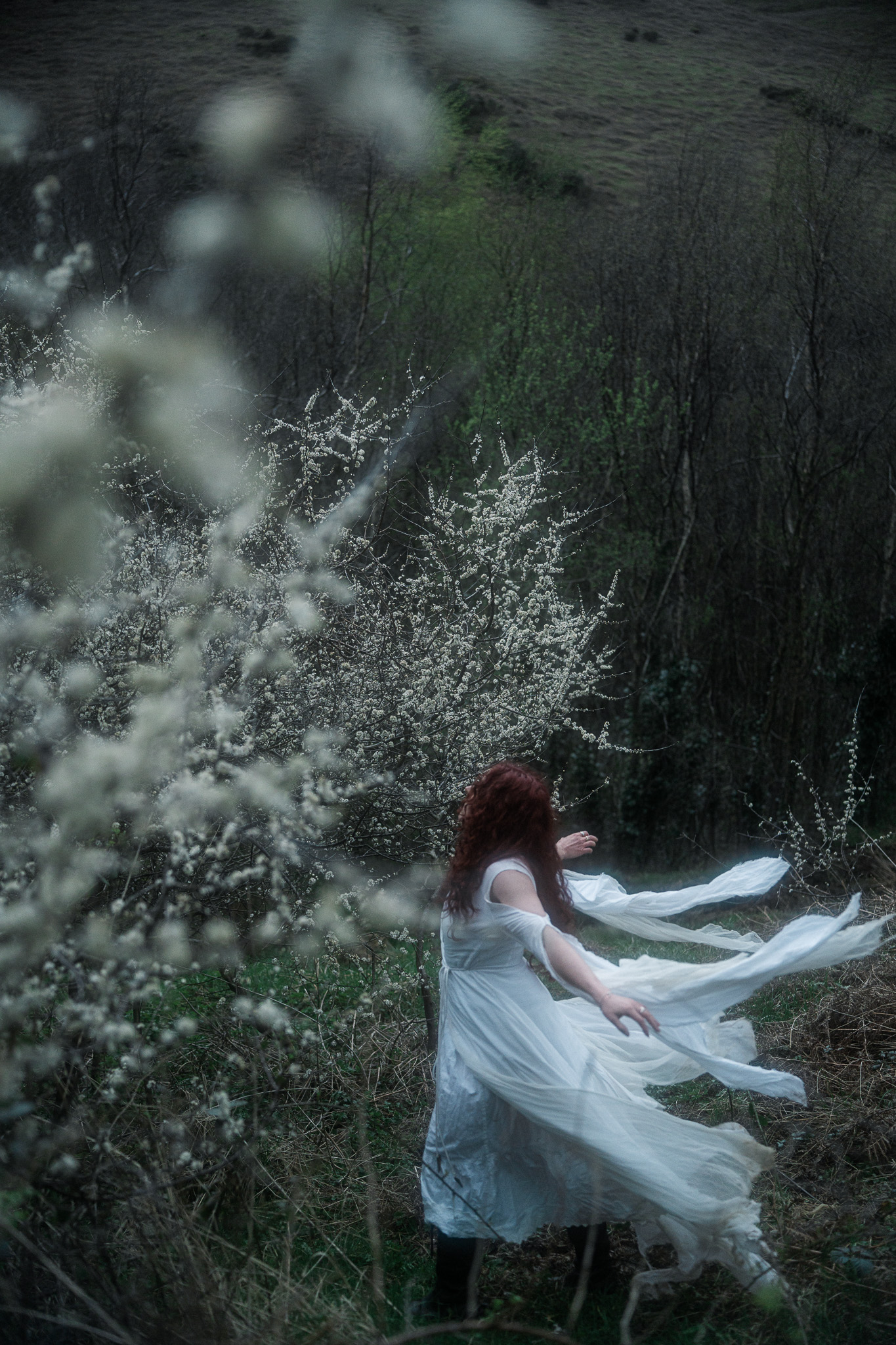
Among the blackthorn from above, Isle of Man. The white of the dress and the white of the blossom; the red hair and the dark branches. The tree is not a backdrop. It is a participant.
When the Lunantishee Leave the Tree
The Lunantishee do not leave the blackthorn except at the full moon. At esbats, as the old sources have it, they depart to pay homage to the moon goddess, dancing by moonlight in the manner of all fairy folk who answer to something larger than themselves. This is the one window of relative safety around the blackthorn: when its guardians are elsewhere, distracted by their devotions.
In other traditions, the Lunantishee are described as binding themselves to the blackthorn at the request of the old ones, ancient peoples who planted the trees around their sacred mounds and tombs and stationed the moon fairies to protect them. A blackthorn tree can live for a century, and its descendants grow where the old tree falls. The protective lineage is unbroken. What was planted around a burial mound two thousand years ago still has its guardians in the hedgerow today.
On the Isle of Man, where ancient burial sites are common and the faerie tradition runs deep and unbroken, this is not abstract history. The blackthorn in the Manx hedgerow at the end of your lane is, in the old understanding, guarded. The question is simply whether you remember that or not.
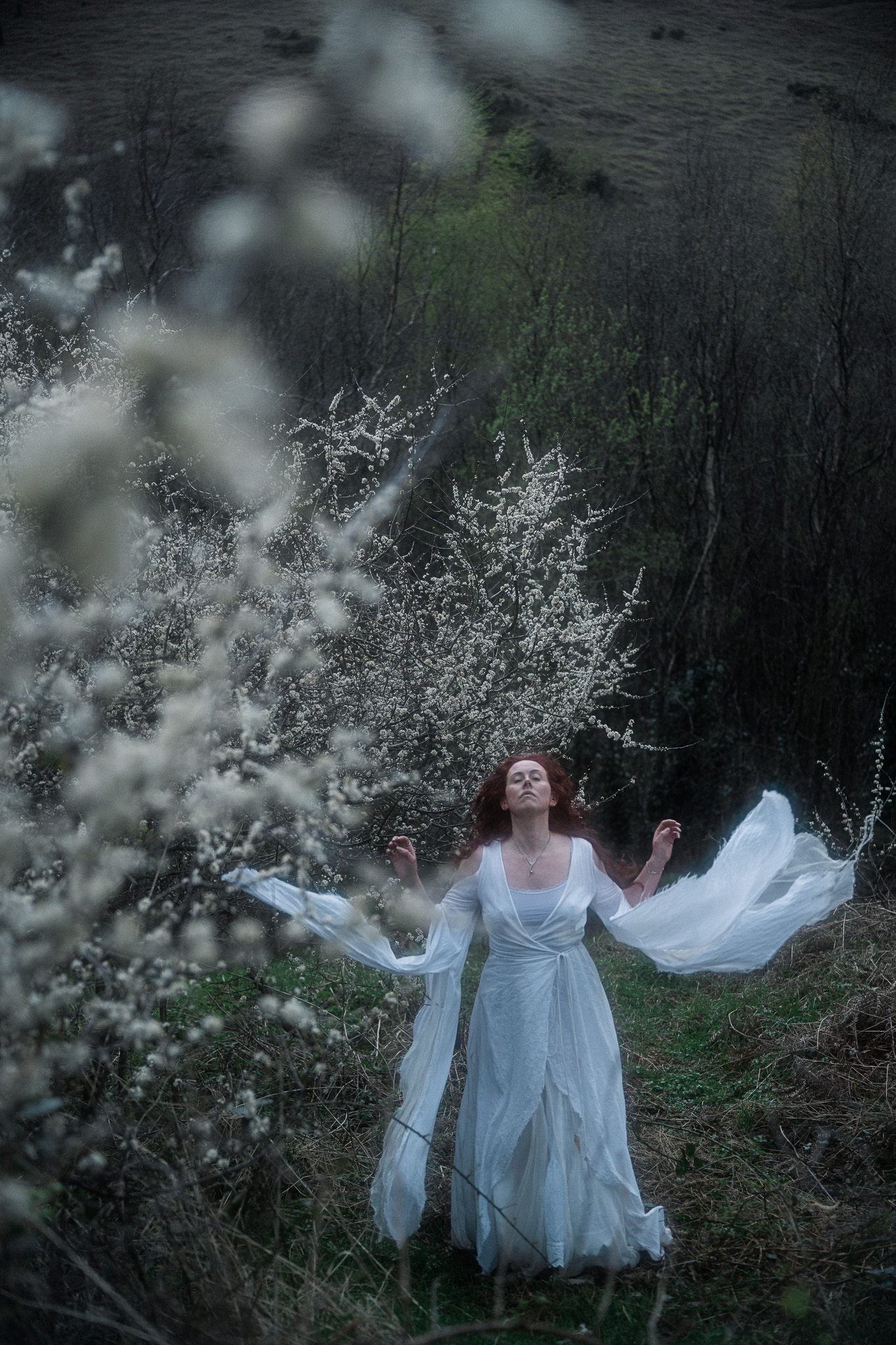
Eyes closed, arms open, surrounded by blackthorn blossom. The correct relationship to a faerie tree is not one of dominance. It is one of attention.
What the Tree Asks of You
Shooting in and around blackthorn teaches you something very quickly: the thorns are long, sharp, and will find any gap in your clothing. They are not metaphorically protective. They are literally so. The old accounts say that a blackthorn thorn wound can turn septic in ways that other scratches do not, a quality the tree has been known for since at least the seventeenth century. John Evelyn in 1664 described its spines as able to pierce a coat of mail.
Photographing among the blossom in April, with the wind coming off the Irish Sea and the branches whipping, is an exercise in the kind of attention the old stories are actually describing. You cannot be careless near blackthorn. You cannot rush it. You move slowly, you ask permission in your own way, and you take what the tree offers rather than taking what you came for. That sounds like folklore. It is also just accurate practical advice.
What the tree offers, when you approach it correctly, is extraordinary. The blossom against dark branches, the contrast of white and black, the way the flowers appear on bare wood before any other growth, the smell of them in cold air. The Lunantishee have stationed themselves at something genuinely worth guarding. That much, at least, I can verify from direct experience.
You cannot rush blackthorn. You move slowly, you ask permission in your own way, and you take what the tree offers. That sounds like folklore. It is also just practical advice.
Ciara — Wild Island MediaIf you are on the Isle of Man in April, find a blackthorn hedge in full blossom and stand in front of it for longer than feels comfortable. Not to photograph it. Just to be there. You will understand, after a few minutes, why the old tradition stationed guardians at this tree. It commands a kind of attention that most things do not.
Come back on the 11th of May if you want to test your luck. I would not recommend it. But I understand the impulse.
Follow along on Instagram for more from the Isle of Man's wild and ancient landscape throughout the Celtic year.
She has Celtic roots. Obviously.
More from the Journal
Field notes from the ancient North: mythology, landscape, and the seasonal pulse of the Celtic world.
Back to Journal →